
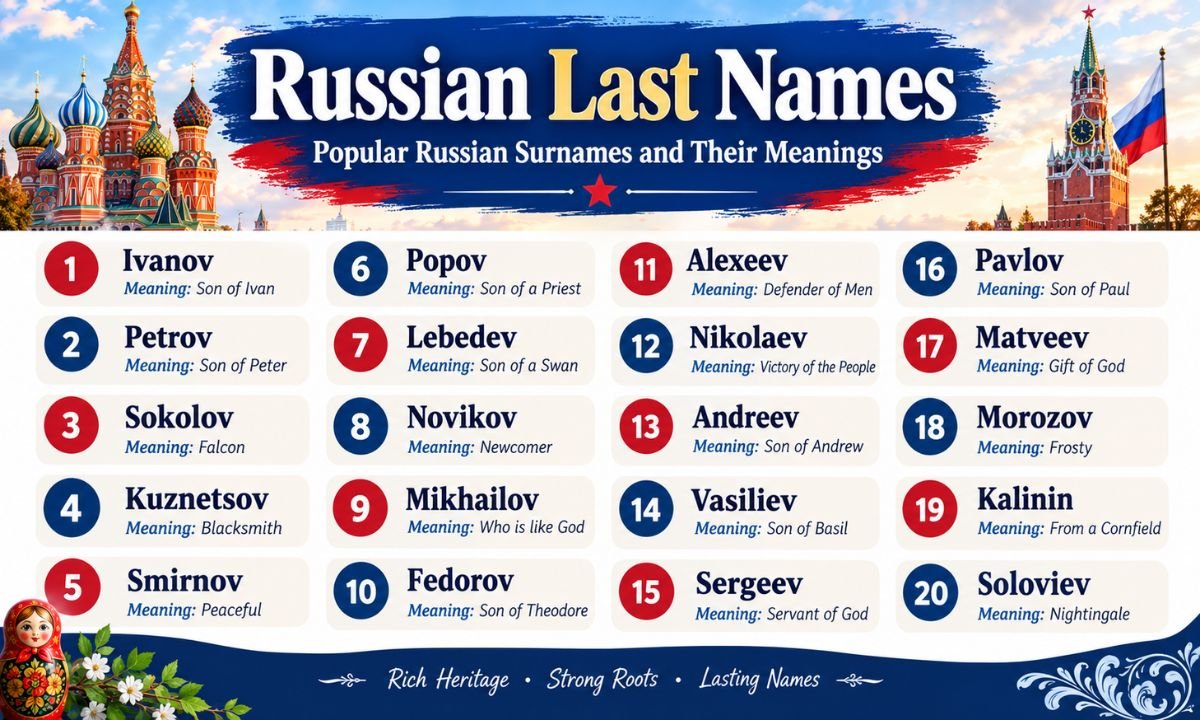
Russian last names carry deep history and meaning. They come from old jobs, places, and even nicknames from long ago. Many of these surnames tell a story about a family’s past. Today, people still use them with pride across Russia and beyond.
Some Russian surnames are very common, like Ivanov or Smirnov. Others are rare and sound unique. You will find names linked to nature, animals, and even personality traits. Each name has its own charm and cultural roots.
This list is perfect for parents, writers, or anyone doing ancestry research. You can find names for babies, book characters, or games. Whether you want something traditional or modern, there is a name here for you. Let’s explore the best Russian last names together.
Pro Tip: Many Russian last names change slightly for men and women. For example, “Ivanov” becomes “Ivanova” for a female. Keep this in mind when picking a name.
Russian Last Names Generator
Russian Last Names Generator
Discover authentic Russian surnames, imperial dynasties, noble lineage, and patronymic meanings inspired by Slavic history and folklore.
Why Choose Russian Last Names
Russian last names are a great pick for many reasons. Here’s why people love them:
- Rich History – Each name has deep roots going back centuries.
- Strong Meanings – Many names come from nature, jobs, or traits like courage.
- Unique Sound – They stand out and feel different from common Western names.
- Great for Characters – Perfect for books, games, and creative projects.
- Cultural Value – They connect you to Russian heritage and tradition.
- Wide Variety – From simple to complex, there’s a name for every taste.
Cute Russian Last Names With Meaning & Origin Table
Cute Russian surnames usually come from nature, animals, or diminutive nicknames — soft-sounding names that started life as affectionate labels rather than formal titles.
Many were given to children or family branches based on a gentle trait, a small creature, or a household object.
These names feel warm and approachable, making them popular picks for fictional characters and pen names alike. The table below breaks down a few standout examples before the full list.
| Last Name | Meaning | Origin |
| Golubev | “Dove” | From golub (dove), a symbol of gentleness |
| Zaitsev | “Hare/Rabbit” | From zayats (hare), a nickname surname |
| Belkin | “Squirrel” | From belka (squirrel) |
| Lisitsyn | “Fox” | From lisitsa (fox) |
| Solntsev | “Sun” | From solntse (sun) |
| Ptashkin | “Little bird” | Diminutive of ptashka (birdie) |
| Romashkin | “Chamomile” | From romashka (daisy/chamomile flower) |
| Yagodkin | “Little berry” | From yagoda (berry) |
| Snegirev | “Bullfinch” | From snegir (bullfinch bird) |
| Vesnin | “Spring” | From vesna (spring season) |
- Golubev
- Zaitsev
- Belkin
- Lisitsyn
- Solntsev
- Ptashkin
- Romashkin
- Yagodkin
- Snegirev
- Vesnin
- Zorkin
- Milov
- Dobrynin
- Laskin
- Nezhin
- Svetlov
- Radugin
- Kotenkov
- Golубь-inspired: Golubtsev
- Zvonkov
- Sinichkin
- Solнышкин (Solnyshkin)
- Teplov
- Yasenev
- Cvetkov (Tsvetkov)
- Listov
- Rosinkin
- Pushinkin
- Iskorkin
- Kolokolchikov
- Malinkin
- Vishenkin
- Yablonkin
- Oreshkin
- Grushkin
- Zvezdочкин (Zvezdochkin)
- Solнцев variant: Solntsov
- Golубин (Golubin)
- Utyonkov
- Kotikov
- Zайчиков variant: Zaychikov
- Medvezhonkov
- Pчёлкин (Pchelkin)
- Bereznyakov
- Kleнов (Klenov)
Pro Tip: When a name looks “cute” in translation, always double-check its actual Russian pronunciation and spelling before using it in a story or product — some diminutive-sounding names can read as overly childish to native speakers. Pair a cute surname with a strong first name to balance the tone.
Traditional Russian Last Names
Traditional Russian surnames are overwhelmingly patronymic, built from a father’s first name plus a suffix like -ov, -ev, or -in (“son of”). These are the most common family names across Russia today, found in records going back to the 16th–18th centuries when the naming system became standardized for taxation and church registries. If you want a surname that feels authentically Russian without any embellishment, this list is the place to start.
- Ivanov
- Petrov
- Sidorov
- Smirnov
- Kuznetsov
- Popov
- Vasiliev
- Sokolov
- Mikhailov
- Novikov
- Fedorov
- Morozov
- Volkov
- Alekseev
- Lebedev
- Semenov
- Egorov
- Pavlov
- Kozlov
- Stepanov
- Nikolaev
- Orlov
- Andreev
- Makarov
- Nikitin
- Zakharov
- Zaitsev
- Solovyov
- Borisov
- Yakovlev
- Grigoriev
- Vorobyov
- Sergeev
- Kuzmin
- Frolov
- Belov
- Komarov
- Voronin
- Kiselev
- Maximov
- Kudryavtsev
- Belyaev
- Bogdanov
- Gerasimov
- Bobrov
- Sviridov
- Tarasov
- Klimov
- Kalinin
- Golubev
Pro Tip: If you’re using a traditional patronymic surname for a fictional family, match the suffix (-ov/-ev vs -in) to the father’s original first name for authenticity — for example, “Ivan” becomes “Ivanov,” while “Kuzma” becomes “Kuzmin.”
Cool Russian Last Names
“Cool” Russian surnames tend to have a sharp, punchy sound in English — short syllables, hard consonants, or a meaning tied to strength, weather, or wild nature. These work well for gamer tags, action-story characters, or anyone who wants a name with an edge. Many double as real, common Russian family names, so they don’t feel invented.
- Volkov (wolf)
- Medvedev (bear)
- Gromov (thunder)
- Molniev (lightning-inspired)
- Buranov (blizzard)
- Kholodov (cold)
- Ognev (fire)
- Zvездин (Zvezdin, star)
- Bурин (Burin, storm-root)
- Vetrov (wind)
- Skalov (rock/cliff)
- Zheleznov (iron)
- Stalnov (steel)
- Klinkov (blade)
- Tigrov
- Bарсов (Barsov, snow leopard)
- Sokolov (falcon)
- Orlov (eagle)
- Yastrebov (hawk)
- Volnov (wave)
- Grozny-inspired: Groznov
- Shtormov
- Serebrov (silver)
- Chernov (black/dark)
- Krutov (steep/tough)
- Dikov (wild)
- Bureyev
- Kremnev (flint)
- Ledenev (ice)
- Morozko-inspired: Morozov
- Vulканов (Vulkanov)
- Yastrov
- Gremuchev
- Shipovnikov
- Kогтев (Kogtev, claw)
- Klыков (Klykov, fang)
- Zvyagin
- Voronov (raven)
- Yasenev
- Kremenchugov
- Skorpionov
- Razinov
- Buyanov (rowdy/wild one)
- Udalov (daring)
- Smelov (brave)
- Otvazhnov
- Krепов (Krepov, sturdy)
- Zheleznyakov
- Ogonkov
- Iskrov (spark)
- Molотов (Molotov)
Pro Tip: “Cool” is subjective across languages — a surname that sounds tough in English (like Volkov, “wolf”) may just sound like an ordinary last name to a Russian speaker. Lean on nature and animal roots if you want the coolness to translate.
Pretty Russian Last Names
Pretty Russian surnames often lean on soft vowel sounds, floral or seasonal roots, and feminine forms ending in -a or -aya. Many trace back to nature imagery — flowers, birds, and light — which gives them an elegant, lyrical quality when spoken aloud. These are popular choices for character names in fiction, especially for heroines or graceful figures.
- Tsvetaeva (flower)
- Solntseva (sun)
- Zvezdina (star)
- Snegurova (snow)
- Vesnina (spring)
- Rosinka
- Svetlova (light)
- Lileyeva (lily-inspired)
- Romashkina (chamomile)
- Kalinina (viburnum berry)
- Malinovskaya (raspberry)
- Vишневская (Vishnevskaya, cherry)
- Yablonskaya (apple tree)
- Beryozkina (birch)
- Zorina (dawn)
- Lastochkina (swallow bird)
- Golubeva (dove)
- Solнышкина (Solnyshkina)
- Zaryanka
- Tumanova (mist)
- Rادugina (Raduzhnaya, rainbow)
- Perlova (pearl)
- Zhemchuzhnaya (pearl)
- Yasnaya (clear/bright)
- Nежинская (Nezhinskaya, tender)
- Krasavina (beauty-rooted)
- Lebedeva (swan)
- Orlovskaya
- Zимняя (Zimnyaya, winter)
- Осенina (Osenina, autumn)
- Letnyaya (summer)
- Vetrova (wind)
- Zарянова (Zaryanova)
- Milaya-inspired: Milova
- Dobryninskaya
- Sнежная (Snezhnaya, snowy)
- Belova (white)
- Serebryakova (silver)
- Zolotova (golden)
- Yantareva (amber)
- Zvonkaya
- Prекрасная (Prekrasnaya)
- Tikhomirova (quiet/peaceful)
- Utrennyaya (morning)
- Vечерняя (Vечерняя, evening)
- Sиреneva (Sirenevaya, lilac)
- Fialkova (violet flower)
- Landyshева (Landysheva, lily of the valley)
- Rябинова (Ryabinova, rowan tree)
- Kленовая (Klenovaya, maple)
Pro Tip: Feminine Russian surnames almost always end in -a or -aya (Ivanov becomes Ivanova). Keep that suffix consistent if you’re building a family tree or cast list so the names read as grammatically correct Russian.
Strong Russian Last Names
Strong-sounding Russian surnames often derive from words for iron, stone, war, or leadership. Historically, many were nicknames earned through a person’s trade, temperament, or physical build before becoming fixed family names. These carry weight and gravity, making them a natural fit for authority figures, warriors, or protagonists who need to command a room.
- Zheleznov (iron)
- Stalnoy
- Kremnev (flint)
- Voinov (warrior)
- Bogatyrev (hero/strongman)
- Silin (strength-rooted)
- Moguchev (mighty)
- Krepkov (sturdy)
- Tverdov (firm/hard)
- Gromov (thunder)
- Buranov (blizzard)
- Skalistov (rocky)
- Kamennev (stone)
- Dubov (oak)
- Medvedev (bear)
- Volkov (wolf)
- Barsov (snow leopard)
- Tигров (Tigrov)
- Orlov (eagle)
- Sokolov (falcon)
- Voevodin (military commander)
- Ratiborov
- Ratnikov (soldier)
- Shchitov (shield)
- Mechnikov (sword-bearer)
- Kopyev (spear)
- Kolчугин (Kolchugin, chainmail)
- Bronev (armor)
- Krепостнов (Krepostnov, fortress)
- Zаставин (Zastavin, outpost)
- Vласов (Vlasov, power-rooted)
- Derzhavin (state/power)
- Gосударев (Gosudarev)
- Vожаков (Vozhakov, leader)
- Атаманов (Atamanov, chieftain)
- Voevodsky
- Druzhinin (retinue/warband)
- Pobedin (victory)
- Slavin (glory)
- Gordeev (pride-rooted)
- Smelov (brave)
- Otважнов (Otvazhnov)
- Neустрашимов (Neustrashimov, fearless)
- Karyagin
- Krутов (Krутov)
- Гранитов (Granitov, granite)
- Skalov
- Bашнев (Bashnev, tower)
- Krепышев (Krepyshev, stocky/strong build)
Pro Tip: Strong surnames pair well with equally firm-sounding first names (like Igor, Dmitri, or Vera) — mismatching a powerful last name with a very soft first name can undercut the effect you’re going for.
Famous Russian Last Names
Famous Russian surnames come from history’s writers, scientists, composers, rulers, and athletes — names most people recognize even outside Russia. Using one of these lends instant familiarity to a character or project, though be mindful that many are tied to real, specific public figures, so they carry strong associations.
- Tolstoy
- Dostoevsky
- Pushkin
- Chekhov
- Tchaikovsky
- Rachmaninoff
- Stravinsky
- Shostakovich
- Gagarin
- Mendeleev
- Pavlov
- Romanov
- Rasputin
- Kandinsky
- Chagall
- Nureyev
- Baryshnikov
- Nabokov
- Gorky
- Turgenev
- Bulgakov
- Akhmatova
- Tsvetaeva
- Mayakovsky
- Yesenin
- Solzhenitsyn
- Kalashnikov
- Sikorsky
- Korolev
- Tsiolkovsky
- Repin
- Vrubel
- Malevich
- Kasparov
- Karpov
- Tretiak
- Fedorov (Sergei, hockey)
- Sharapova
- Navalny
- Khrushchev
- Brezhnev
- Yeltsin
- Putin
- Lavrov
- Zhukov
- Suvorov
- Kutuzov
- Ushakov
- Popov (Alexander, radio)
- Lomonosov
Pro Tip: Because these names are attached to real historical and public figures, avoid using them for fictional characters in a way that could be confused with the real person — Claude and most style guides recommend inventing a similar-sounding but original surname instead.
Powerful Russian Last Names
Powerful Russian surnames overlap with “strong” ones but lean more toward rule, dominance, and command rather than raw physical strength — think titles, thrones, and old words for authority. These fit rulers, generals, or any character meant to project control and influence.
- Derzhavin (state power)
- Vlastov
- Gосударев (Gosudarev)
- Samoderzhavin
- Тронов (Tronov, throne)
- Ventsov (crown)
- Koronin (crown-rooted)
- Skipetrov (scepter)
- Verховный variant: Verkhovny
- Влиятельнов (Vliyatelnov, influential)
- Mогутин (Mogutin, powerful)
- Могуществов (Mogushchestvov)
- Сильнов (Silnov)
- Владычин (Vladychin, sovereign)
- Владимиров (Vladimirov)
- Всеволодов (Vsevolodov)
- Ярославов (Yaroslavov)
- Святославов (Svyatoslavov)
- Изяславов (Izyaslavov)
- Ростиславов (Rostislavov)
- Правителев (Pravitelev, ruler)
- Императоров (Imperatorov)
- Regentov
- Судьбин (Sudbin, fate-rooted)
- Roковой variant: Rokovov
- Nепобедимов (Nepobedimov, unbeatable)
- Grозный variant: Groznov
- Могучев (Moguchev)
- Верховников (Verkhovnikov)
- Владетелев (Vladetelev)
- Державнов (Derzhavnov)
- Самовластов (Samovlastov)
- Полководцев (Polkovodtsev, commander)
- Voevodov
- Атаманов (Atamanov)
- Гетьманов (Getmanov, hetman)
- Царёв (Tsarev)
- Королёв (Korolev, king-rooted)
- Князев (Knyazev, prince-rooted)
- Boyarov (boyar/noble)
- Vельможин (Velmozhin, dignitary)
- Sановников (Sanovnikov)
- Wласьев (Vlasyev)
- Могущий variant: Moguschy
- Velichaev
- Слав variant: Slavnov
- Триумфов (Triumfov)
- Победоносцев (Pobedonostsev)
- Grandов (Grandov)
- Majestov
Pro Tip: Many “powerful” invented names above are built from real Russian roots (like knyaz for prince or tsar for emperor) but aren’t common modern surnames — great for fantasy or historical fiction, less ideal if you need a name that would pass as an everyday, realistic Russian last name.
Royal Russian Last Names
Russia’s actual noble and royal houses used surnames tied to land grants, princely titles, and ancient boyar families — many of these survived from the medieval period through the fall of the Romanov dynasty in 1917. These are the real family names of dukes, princes, and tsars, not invented titles, making them ideal for anyone researching Russian aristocracy or writing period fiction.
- Romanov
- Rurikovich
- Golitsyn
- Yusupov
- Obolensky
- Trubetskoy
- Vorontsov
- Sheremetev
- Dolgorukov
- Odoevsky
- Shakhovskoy
- Gagarin (princely line)
- Repnin
- Khilkov
- Lopukhin
- Naryshkin
- Bariatinsky
- Volkonsky
- Kurakin
- Belosselsky
- Meshchersky
- Gorchakov
- Baryatinsky
- Дashkov (Dashkov)
- Chernyshev
- Panin
- Buturlin
- Musin-Pushkin
- Apraksin
- Stroganov
- Yusupov-Sumarokov
- Vяземский (Vyazemsky)
- Volynsky
- Shuisky
- Godunov
- Романов-Holstein-Gottorp (historical branch)
- Lobanov-Rostovsky
- Kropotkin
- Tolstoy (noble branch)
- Bezborodko
- Kочубей (Kochubey)
- Zubov
- Orlov (noble line)
- Potyomkin
- Razumovsky
- Menshikov
- Bestuzhev
- Дolгорукий (Dolgoruky)
- Сумароков (Sumarokov)
- Демидов (Demidov)
Pro Tip: Real Russian noble surnames are tied to specific historical families, so if you use one for a character, expect readers familiar with Russian history to associate it with that lineage — invent a variant spelling if you want the royal feel without the direct historical link.
Russian Last Names Boy
For a boy’s full name, Russian surnames typically stay in their base masculine form (ending in -ov, -ev, -in, or -sky), pairing naturally with classic Russian first names like Ivan, Dmitri, or Alexei. This list highlights masculine-form surnames that read as strong, classic choices for a son or a male character.
- Ivanov
- Petrov
- Volkov
- Sokolov
- Morozov
- Orlov
- Zaitsev
- Belyaev
- Kuznetsov
- Novikov
- Fedorov
- Gromov
- Medvedev
- Tarasov
- Klimov
- Nikitin
- Yakovlev
- Grigoriev
- Vorobyov
- Sergeev
- Kuzmin
- Frolov
- Voronin
- Kiselev
- Maximov
- Bogdanov
- Gerasimov
- Sviridov
- Kalinin
- Golubev
- Zakharov
- Solovyov
- Borisov
- Andreev
- Makarov
- Egorov
- Pavlov
- Kozlov
- Stepanov
- Nikolaev
- Semenov
- Alekseev
- Mikhailov
- Vasiliev
- Popov
- Smirnov
- Sidorov
- Romanov
- Shestakov
- Bykov
Pro Tip: Pair a masculine surname’s suffix with your chosen first name’s rhythm — a three-syllable first name like “Alexander” often flows better with a shorter surname like “Orlov” than with a longer one like “Kudryavtsev.”
Russian Last Names Girl
Girls’ surnames in Russian grammar shift to a feminine ending — most often -a or -aya is added to the masculine root (Petrov becomes Petrova, Volkov becomes Volkova). This list gives you the feminine forms directly so you can pair them with a first name without needing to convert them yourself.
- Ivanova
- Petrova
- Smirnova
- Kuznetsova
- Sokolova
- Volkova
- Orlova
- Belyaeva
- Novikova
- Fedorova
- Morozova
- Tarasova
- Klimova
- Nikitina
- Yakovleva
- Grigorieva
- Vorobyova
- Sergeeva
- Kuzmina
- Frolova
- Voronina
- Kiseleva
- Maximova
- Bogdanova
- Gerasimova
- Sviridova
- Kalinina
- Golubeva
- Zakharova
- Solovyova
- Borisova
- Andreeva
- Makarova
- Egorova
- Pavlova
- Kozlova
- Stepanova
- Nikolaeva
- Semenova
- Alekseeva
- Mikhailova
- Vasilieva
- Popova
- Sidorova
- Romanova
- Zaitseva
- Lebedeva
- Vlasova
- Tsvetaeva
- Sharapova
Pro Tip: Some famous women (like tennis star Maria Sharapova) already made certain feminine surnames widely known outside Russia — great if you want built-in recognizability, but pick a less iconic option if you need something more original.
Mafia Russian Last Names
Fiction and film have built a specific image of the “Russian mafia” surname — short, hard-edged names often paired with a menacing nickname (a klichka) rather than used alone. These work well for crime dramas, games, or antagonist characters who need an intimidating presence.
- Volkov “The Wolf”
- Chernov “Blackie”
- Zheleznov “Iron”
- Krutov “The Tough One”
- Bykov “The Bull”
- Medvedev “The Bear”
- Groznov “The Terrible”
- Udalov “The Bold”
- Molotov
- Karyagin
- Bandurin
- Shramov (from shram, scar)
- Nozhov (from nozh, knife)
- Kулаков (Kulakov, fist)
- Тенев (Tenev, shadow)
- Скорпионов (Skorpionov)
- Волчок (Volchok, “little wolf”)
- Рysев (Rysev, lynx)
- Барсуков (Barsukov, badger)
- Гадюкин (Gadyukin, viper)
- Кобранов (Kobranov, cobra-root)
- Стальнов (Stalnov)
- Крысин (Krysin, rat)
- Ворон (Voronov, raven/crow)
- Гробовщиков (Grobovshchikov, undertaker)
- Могильщиков (Mogilshchikov, gravedigger)
- Разбойников (Razboynikov, bandit)
- Головорезов (Golovorezov, cutthroat)
- Атаманов (Atamanov)
- Бритвин (Britvin, razor)
- Топоров (Toporov, axe)
- Кинжалов (Kinzhalov, dagger)
- Пулькин (Pulkin, bullet)
- Патронов (Patronov, cartridge)
- Стволов (Stvolov, “the barrel”)
- Дымов (Dymov, smoke)
- Теневой variant: Tenevoy
- Ночнов (Nochnov, night-rooted)
- Мрачнов (Mrachnov, grim)
Pro Tip: In crime fiction, the surname usually matters less than the nickname built alongside it — consider giving your character both a plain, forgettable surname and a sharp street name for a more authentic feel.
Unique Russian Last Names
Unique Russian surnames step outside the common patronymic pattern — some come from old professions, geographic features, or unusual nicknames that never became widespread. These stand out precisely because they’re rare, making them a good pick when you want a Russian-sounding name that doesn’t feel like every other “-ov” on the list.
- Kolokoltsev (bell-maker)
- Bondarev (cooper/barrel-maker)
- Gonchar (potter)
- Melnikov (miller)
- Kuznetsov (blacksmith — common, but occupational)
- Plotnikov (carpenter)
- Rыбаков (Rybakov, fisherman)
- Охотников (Okhotnikov, hunter)
- Пастухов (Pastukhov, shepherd)
- Кожевников (Kozhevnikov, tanner)
- Скорняков (Skornyakov, furrier)
- Ткачёв (Tkachev, weaver)
- Гончаров (Goncharov, potter)
- Бондарь (Bondar)
- Извозчиков (Izvozchikov, coachman)
- Мостовой (Mostovoy, “of the bridge”)
- Заречный (Zarechny, “beyond the river”)
- Загорский (Zagorsky, “beyond the mountain”)
- Подлесный (Podlesny, “under the forest”)
- Нагорный (Nagorny, “of the hills”)
- Заводной (Zavodnoy, “of the factory”)
- Колодезный (Kolodezny, “of the well”)
- Мельник (Melnik)
- Пекарев (Pekarev, baker)
- Свечников (Svechnikov, candle-maker)
- Часовщиков (Chasovshchikov, watchmaker)
- Печников (Pechnikov, stove-maker)
- Столяров (Stolyarov, joiner)
- Кузнечиков — playful variant
- Огородников (Ogorodnikov, gardener)
- Садовников (Sadovnikov, orchard-keeper)
- Виноградов (Vinogradov, “of the grapevine”)
- Черёмухин (Cheryomukhin, bird cherry tree)
- Ольхин (Olkhin, alder tree)
- Ивнягин (Ivnyagin, willow grove)
- Осокин (Osokin, sedge grass)
- Тростников (Trostnikov, reed)
- Камышов (Kamyshov, bulrush)
- Родников (Rodnikov, spring/well)
- Ручьёв (Ruchyov, stream)
- Озёрин (Ozyorin, lake)
- Болотов (Bolotov, marsh)
- Полянин (Polyanin, clearing)
- Долинин (Dolinin, valley)
- Взгорьев (Vzgoryev, hillock)
Pro Tip: Occupational and geographic surnames like these tend to be regionally clustered in Russia rather than nationwide, so they can add subtle authenticity if your story or research is tied to a specific area (villages, river towns, forested regions).
Tips For Choosing Russian Last Names
Picking the right Russian surname is about more than sound — grammar, gender agreement, and cultural context all matter if you want the name to hold up under scrutiny. A few practical guidelines will save you from common mistakes, whether you’re naming a novel’s cast, a game character, or researching your own family tree.
- Match gender endings: masculine surnames end in -ov/-ev/-in/-sky; feminine forms add -a or -aya (Petrov → Petrova).
- Consider the patronymic pattern: most traditional surnames literally mean “son/daughter of [name],” so check what root name it implies.
- Watch for real historical or celebrity ties before using a famous surname for a fictional character.
- Balance sound and meaning — a name that looks striking in English may translate to something plain (or odd) in Russian.
- For period-accurate fiction, match the surname’s style (noble, occupational, patronymic) to your character’s social class and era.
- If accuracy matters, run the name past a native speaker or reliable Russian-language source before finalizing it.
- Keep spelling transliteration consistent throughout your project — Russian names often have multiple valid English spellings (e.g., Tchaikovsky vs. Chaikovsky).
Pro Tip: When in doubt, start from a real, common surname (like Ivanov or Sokolov) and modify it slightly rather than inventing one from scratch — this keeps the name grounded and pronounceable while still letting you make it your own.
Final Thoughts
Russian last names carry deep history and meaning. They come from old jobs, places, and even nicknames from long ago. Many of these surnames tell a story about a family’s past. Today, people still use them with pride across Russia and beyond.
Some Russian surnames are very common, like Ivanov or Smirnov. Others are rare and sound unique. You will find names linked to nature, animals, and even personality traits. Each name has its own charm and cultural roots.
This list is perfect for parents, writers, or anyone doing ancestry research. You can find names for babies, book characters, or games. Whether you want something traditional or modern, there is a name here for you. Let’s explore the best Russian last names together.
Pro Tip: Many Russian last names change slightly for men and women. For example, “Ivanov” becomes “Ivanova” for a female. Keep this in mind when picking a name.
“FAQs”
What is a very Russian last name?
Ivanov is one of the most Russian last names out there. It comes from the first name Ivan, which means “John.” You will see this surname all over Russia.
What is a good Slavic last name?
Novak is a great Slavic last name. It means “newcomer” in many Slavic languages. It is easy to say and has a strong sound.
What is Vladimir Putin’s last name?
Vladimir Putin’s last name is Putin. It comes from the old Russian word “put,” which means “path” or “way.”
What are some wealthy Russian surnames?
Names like Romanov and Yusupov are linked to wealth and royalty. These families once held great power in old Russia. They still carry a sense of status today.
What is a cool Russian name?
Volkov is a cool Russian name. It means “wolf,” which gives it a strong and fierce feel. Many people like it for its bold sound.
What is the most luxurious last name?
Romanov is seen as the most luxurious Russian name. It belonged to Russia’s last royal family. It still stands for power and elegance today.
What is the rarest Russian name?
Zima is a rare Russian last name. It means “winter” in Russian. Not many families carry this unique name today.
What is the longest Russian surname?
Konstantinopolsky is one of the longest Russian surnames. It has roots tied to the city Constantinople. It is rare and hard to say quickly.
What is a tough Russian name?
Medvedev sounds tough and strong. It comes from the word “medved,” meaning “bear.” It gives a powerful, fearless feel.
What is a full Russian name?
A full Russian name has three parts. It includes a first name, a patronymic (father’s name), and a last name. For example, Ivan Petrovich Smirnov.

Ch Shahid is a passionate names blogger and creative writer who loves helping people discover unique, meaningful, funny, and memorable names. Through his blog, he shares carefully researched name ideas, name meanings, nicknames, pet names, character names, and creative naming inspiration.